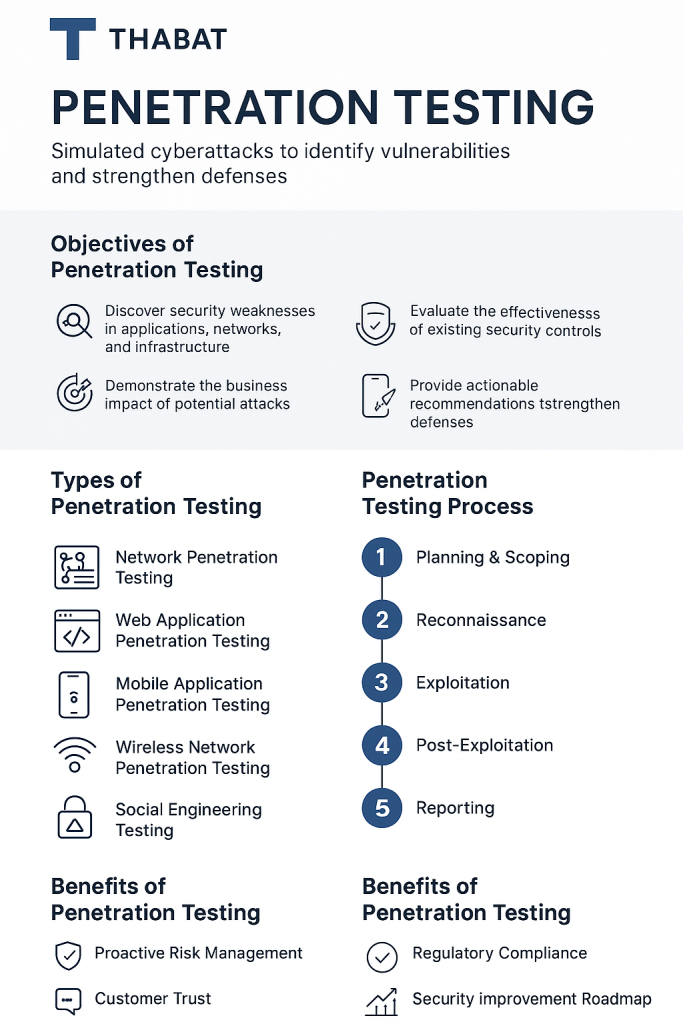
Penetration Testing is a simulated cyberattack conducted by security professionals to evaluate the resilience of an organization’s systems, networks, and applications against real-world threats.
It’s designed to identify vulnerabilities before malicious actors can exploit them.
Objectives of Penetration Testing
Discover security weaknesses in applications, networks, and infrastructure.
Evaluate the effectiveness of existing security controls.
Demonstrate the business impact of potential attacks.
Provide actionable recommendations to strengthen defenses.
Types of Penetration Testing
Network Penetration Testing
Internal and external network security assessment.
Identifies vulnerabilities like open ports, misconfigurations, and outdated software.
Web Application Penetration Testing
Focused on websites, APIs, and web apps.
Tests for vulnerabilities like SQL Injection, XSS, CSRF, authentication flaws, and insecure direct object references.
Mobile Application Penetration Testing
Evaluates Android and iOS apps.
Checks for insecure data storage, weak encryption, API security flaws, and insecure permissions.
Wireless Network Penetration Testing
Tests Wi-Fi networks for weak encryption, rogue access points, and poor authentication.
Social Engineering Testing
Simulates phishing, vishing (voice phishing), and physical intrusion attempts.
Physical Penetration Testing
Tests physical security controls like locks, access cards, and on-site procedures.
Penetration Testing Process
Planning & Scoping – Define objectives, rules of engagement, and test boundaries.
Reconnaissance – Gather information about the target environment.
Exploitation – Attempt to gain unauthorized access.
Post-Exploitation – Assess the potential impact of a breach.
Reporting – Deliver a detailed report with findings, risk ratings, and remediation guidance.
Re-Testing – Verify that vulnerabilities have been fixed.
Benefits of Penetration Testing
- Proactive Risk Management – Address vulnerabilities before attackers exploit them.
- Regulatory Compliance – Meets PCI DSS, ISO 27001, and other standards’ testing requirements.
- Customer Trust – Demonstrates commitment to protecting data.
- Security Improvement Roadmap – Provides clear next steps for remediation.